


AI Readiness and Exploitation
By Grant Crawley · 4 June 2026

Over the last few years, Artificial Intelligence (AI), and more specifically Generative AI, has matured and moved quickly into the business world. AI now appears everywhere, but organisations only implement it successfully when they understand the business problem, the data, the governance requirements and the adoption plan.
For most organisations, the challenge is no longer whether AI can do something useful. The challenge is knowing where to start, what to trust, how to manage the risk and how to turn experimentation into measurable business value.
Your problems solved
Many organisations struggle to move beyond the hype. They often find it difficult to align AI capabilities with strategic objectives, operational workflows and customer needs. This is where our AI Readiness and Exploitation consultancy accelerator helps.
We help your business demystify AI, assess its current readiness and develop tailored strategies to integrate AI into operations effectively. By focusing on measurable outcomes, smooth implementation and sustainable adoption, we help organisations use technologies such as Generative AI, predictive analytics, automation and intelligent agents to drive innovation, efficiency and competitive advantage.
Whether you are starting your AI journey or scaling existing initiatives, our expertise gives you a practical, results-driven approach to AI transformation.
We have worked with OpenAI API technologies for many years, testing and developing advanced large language model (LLM) solutions. Our sister company, Rezon8AI, has a fully functional solution that uses AI technologies to help businesses take control of their online reputation.
Being prepared for AI is not just about creating effective prompts. Prompts matter, but they have limited value if your business cannot use proprietary information safely, your data is inaccessible or unreliable, or your staff do not know how to use the tools responsibly.
We can help your business get more out of OpenAI ChatGPT, Anthropic Claude, Google Gemini and Microsoft Copilot by speeding up knowledge workflows and improving the quality of outputs.

What AI readiness really means
AI readiness is not a single technology assessment. It is a review of your business, data, processes, people and risk position.
A useful AI readiness review should answer questions such as:
- Business value: Which bottlenecks, knowledge workflows or customer journeys could AI improve first?
- Data readiness: Can your teams access the right data, in the right format, with the right permissions?
- Process maturity: Have you documented, measured and understood the workflows you want to improve?
- People readiness: Do staff know how to use AI tools safely, challenge outputs and spot hallucinations?
- Governance: Do you have approved tools, acceptable use policies, risk ownership and escalation routes?
- Integration: Will AI sit outside the business as another disconnected tool, or become part of your operating model?
- Risk and compliance: Are you managing privacy, security, bias, explainability, intellectual property and operational resilience?
This is why our approach starts with the business outcome, not the tool. Buying a “shiny” AI product and then looking for a use case usually creates cost, confusion and fragmented adoption. A better approach is to find a real problem, measure the baseline, test a controlled pilot and scale what works.
Common signs your organisation is not ready for AI
You may not be ready to scale AI if:
- teams already use unapproved AI tools without oversight;
- staff copy sensitive information into public AI tools;
- the organisation has no inventory of AI systems or AI-enabled software;
- business processes are undocumented or inconsistent;
- leaders cannot define what success looks like;
- staff have not received AI literacy training;
- there is no policy for when humans must review AI output;
- risk, legal, information security and operations teams do not get involved early enough.
These issues are common, and you can fix them. The important step is to find them early, before AI adoption becomes fragmented across departments.
Virtco’s AI risk material places particular emphasis on discovering and cataloguing both sanctioned AI and “shadow AI”. This creates visibility of AI usage, reduces unauthorised use and classifies systems by risk tier, business criticality and data sensitivity.
From experimentation to exploitation
AI exploitation begins when AI stops being a side experiment and starts delivering repeatable business value.
That usually means moving through five practical stages.
1. Assess the current position
We review your business goals, processes, systems, data, existing AI usage and risk exposure. This includes looking for obvious AI systems and hidden AI usage in software-as-a-service platforms, cloud services, productivity tools and departmental subscriptions.
2. Prioritise the right use cases
Not every AI idea deserves attention first. We help you identify use cases that are both valuable and feasible. The strongest early candidates are usually repetitive, knowledge-heavy workflows with a clear baseline, a measurable improvement opportunity and a manageable risk profile.
3. Build a safe pilot
A pilot should not become an uncontrolled experiment on live customers or sensitive data. We typically recommend a safe sandbox environment, clear success criteria and a human-in-the-loop model. In practical terms, AI may draft, summarise, classify, search or recommend, but a trained person reviews the output before it matters.
Virtco’s approach treats this as a de-risked model. AI drafts or analyses, while a human reviews the output and makes the decision. This turns AI into an augmentation tool rather than an uncontrolled replacement.
4. Train the team and manage adoption
Technology is often the easier part. People change determines whether many AI programmes succeed or fail.
Your teams need to understand:
- which AI tools the organisation has approved;
- which data they can and cannot use;
- how to prompt effectively;
- how to challenge outputs;
- how to recognise hallucinations and bias;
- when human review is mandatory;
- how to report concerns or incidents.
A clear AI acceptable use policy is essential. Virtco’s AI Risk Framework recommends maintaining an approved AI tools list, preventing staff from entering customer personally identifiable information or confidential business information into unapproved tools, and ensuring AI does not make decisions affecting people without human review.
5. Scale what works
Once a pilot has proved value, the next step is not to buy five disconnected tools. That creates silos.
The goal is to build an integrated AI operating model where data, workflows and systems connect sensibly. In our own content planning, we describe this as moving towards an “Agentic AI Mesh”: specialist agents and AI-enabled workflows that can work together across finance, sales, operations and reporting, rather than creating isolated pockets of automation.
The governance foundations for safe AI adoption
AI readiness is incomplete without governance. Organisations need enough structure to prevent risk, but not so much bureaucracy that innovation stops.
A sensible governance model should include:
- an AI inventory;
- clear system owners and risk owners;
- an approved AI tools list;
- data classification rules;
- an acceptable use policy;
- risk assessment before high-risk deployment;
- incident reporting routes;
- ongoing monitoring;
- periodic review of production AI systems.
Virtco’s AI Risk Framework™ provides a comprehensive, adaptive approach to identifying, quantifying and managing AI implementation risk. It works as a living system that evolves with organisational maturity, integrates with governance frameworks such as Control Objectives for Information and Related Technologies (COBIT) and Information Technology Infrastructure Library (ITIL), and supports implementation using International Organization for Standardization and International Electrotechnical Commission (ISO/IEC) 42001 principles.
The framework has four practical layers:
- Governance: policies, accountability, risk appetite and decision rights.
- Identification: AI asset discovery, shadow AI discovery, classification and risk scenarios.
- Assessment and quantification: likelihood, impact, key risk indicators and prioritisation.
- Management and monitoring: treatment plans, controls, continuous monitoring, incident response and improvement.
This matters because AI risk management cannot be a one-time assessment. AI systems change, models drift, new threats emerge and regulations continue to evolve. Virtco’s framework treats AI risk management as a continuous assessment loop rather than a periodic project.
Classifying AI risk before you scale
Not all AI use cases carry the same level of risk.
An internal meeting summariser is very different from an AI system used in recruitment, credit decisions, healthcare diagnostics or customer-facing advice. That is why classification plays a crucial role in readiness.
Virtco’s AI Risk Framework classifies AI systems across dimensions including risk tier, business criticality and data sensitivity. High-risk examples include systems that significantly affect people’s rights, safety or livelihoods, such as hiring decisions, credit scoring, healthcare diagnostics, educational assessment or benefits determination.
A practical classification exercise helps decide:
- how much governance the use case requires;
- who must approve it;
- which controls are mandatory;
- whether a human must remain in the loop;
- how often the organisation should review the system;
- which monitoring and incident response arrangements are needed.
This approach makes AI adoption safer, more transparent and easier to explain to leaders, regulators, customers and staff.
Managing the real risks, not just the obvious ones
Many AI risks are familiar: data leakage, privacy breach, poor access control and weak vendor management. Others are more specific to Generative AI and LLM-based systems.
Examples include:
- Prompt injection: malicious instructions that try to override system instructions or leak information.
- Indirect prompt injection: hidden instructions embedded in emails, documents, websites or other content that an AI system processes.
- Hallucination: confident but incorrect outputs.
- Bias and unfair outcomes: especially in people-related decisions.
- Model drift: gradual performance decline as real-world conditions change.
- Over-reliance: staff trusting outputs without challenge.
- Shadow AI: unapproved tools used outside normal controls.
Virtco’s framework identifies prompt injection and jailbreaking as active threats for organisations using LLMs and Generative AI, particularly in customer-facing chatbots, AI assistants and automated content moderation.
Good AI readiness work therefore includes practical controls such as input validation, output checking, access controls, approved tool lists, staff training, monitoring and human review for sensitive actions.
Measuring value and return on investment
AI exploitation should be outcome-led. If you cannot measure the “before”, you will struggle to prove the “after”.
Before launching a pilot, we help organisations define:
- the manual effort currently required;
- the cost of the current process;
- the error rate or quality issue;
- the customer or employee pain point;
- the expected improvement;
- the risk controls required;
- the adoption plan;
- the success criteria.
This makes it easier to decide whether to continue, stop, redesign or scale the initiative. It also gives leaders a business case grounded in evidence rather than enthusiasm.
Virtco’s AI Risk Framework also connects risk decisions to cost-benefit analysis, key risk indicators and control effectiveness. This helps organisations understand whether a control is proportionate to the risk it reduces.
A practical 60-day AI readiness roadmap
For many organisations, a focused 60-day cycle is a useful first step.
Weeks 1 to 2: Assessment
Identify the business pain, review current AI usage, assess data readiness, discover shadow AI and understand where risk already exists.
Week 3: Strategy
Prioritise use cases, define the baseline, agree success criteria, identify risk owners and decide which pilot should go first.
Weeks 4 to 7: Pilot
Build a controlled pilot in a safe environment. Keep a human in the loop. Test the workflow, measure performance, capture user feedback and record the risks.
Week 8: Adoption plan
Train the team, finalise acceptable use guidance, agree support arrangements, prepare communications and decide whether to scale, iterate or stop.
Virtco’s content planning approach treats this roadmap as deliberately practical: assessment, strategy, pilot, adoption and then scale. Once the first value case has been proven, the next improvement cycle begins.
The virtco® Accelerator
At virtco®, we bring deep technology expertise and extensive experience from guiding clients through digital workplace transformations. Using our structured and proven virtco® Consulting Cycle, we help you tackle challenges while minimising risk and disruption to your business.
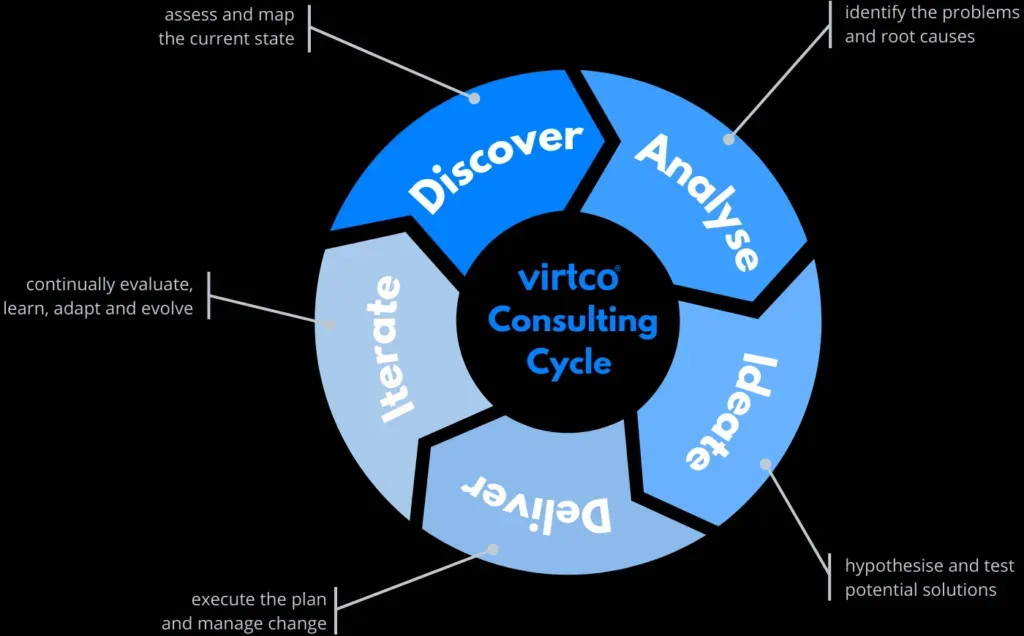
Discover. We assess and map your current state, evaluate your organisation’s maturity and define clear objectives. This includes setting success criteria and creating a roadmap for achieving your goals.
Analyse. We pinpoint problems, identify root causes and uncover opportunities. We then define practical steps to move your business closer to its strategic goals.
Ideate. We develop and test potential solutions to ensure they deliver the intended impact and align with your business needs.
Deliver. Once we have validated a solution, we move to execution, implement the change across your organisation and manage the impact.
Iterate. After implementation, we focus on continuous evaluation and learning. By adapting and improving, we drive ongoing progress, spark new discoveries and move your business closer to its long-term vision.
What you can expect from an AI readiness engagement
Depending on your starting point, an AI Readiness and Exploitation engagement may include:
- an AI readiness assessment;
- a current-state review of processes, systems and data;
- AI asset and shadow AI discovery;
- use case prioritisation;
- risk classification and governance recommendations;
- an acceptable use policy and approved tools approach;
- pilot design and success criteria;
- data and integration recommendations;
- staff enablement and AI literacy guidance;
- a roadmap for scaling successful use cases.
The aim is not to make AI feel more complicated. The aim is to make it safer, clearer and more commercially useful.
Ready to move from AI interest to AI value?
If your organisation is experimenting with AI but lacks a clear route to value, now is the time to put structure around it.
Start by identifying the business problem, understanding your data, setting sensible guardrails and proving value through a controlled pilot. From there, you can scale with confidence.
To discuss how virtco® can help you assess readiness, prioritise use cases and build a practical AI roadmap, visit the main virtco® website.