


AI Risk Framework and Risk Radar
By Grant Crawley · 6 June 2026
Making AI safe enough to scale
Artificial intelligence (AI) is no longer a side experiment for most organisations. It is becoming part of operational workflows, customer service, compliance, knowledge management and decision support. That creates opportunity, but it also changes the organisation’s risk profile.
The question is not simply, “Can we build this?” It is, “Can we operate this safely, prove the benefit, and keep it within our risk appetite as it scales?”
That is the role of the virtco® AI Risk Framework™, referred to internally as V-ARF, and the virtco® Risk Radar™. Together, they provide a practical governance layer for AI-enabled change: one part structured risk methodology, one part executive visibility tool.
The latest V-ARF material makes an important point clear: AI risk management should be treated as a living system, not a one-off assessment. The framework evolves with organisational maturity, integrates with established governance frameworks such as Control Objectives for Information and Related Technologies (COBIT) and Information Technology Infrastructure Library (ITIL), and produces decision-ready outputs through the Risk Radar™.
Why AI risk needs a different operating model
Traditional technology risk management often concentrates on delivery: scope, budget, timeline and technical failure. Those risks still matter. But AI introduces a wider set of concerns:
- Is the AI initiative tied to a measurable business outcome?
- Is the data accessible, accurate, governed and appropriate?
- Are privacy, security and compliance controls strong enough?
- Are users trained and willing to adopt the new way of working?
- Can decisions, prompts, outputs and model behaviour be explained or audited?
- What happens when the system scales beyond a pilot?
- Who is accountable if an AI-enabled decision causes harm?
- How will model drift, hallucination, bias, prompt injection or third-party AI failure be detected and managed?
virtco®’s own AI readiness work frames this as a readiness gap: executive enthusiasm for AI can run ahead of operational capability, leaving organisations exposed to pilot purgatory, poor data foundations and governance gaps. The assessment material specifically calls out ungoverned data, shadow AI and missing ethical frameworks as common failure modes that organisations need to diagnose before they scale investment.
For virtco®, that makes AI risk management a continuous discipline, not a document produced at the end of discovery.
What is the virtco® AI Risk Framework™?
The virtco® AI Risk Framework™ is the controlling risk methodology used when an engagement involves AI. It sits underneath virtco®’s wider benefits-led delivery approach and provides the risk-and-dependency layer that keeps AI initiatives aligned to business value, adoption readiness and operational control.
V-ARF is built around two connected ideas:
- A four-layer structural model: Governance & Policy, Risk Identification, Assessment & Quantification, and Management & Monitoring.
- A seven-step continuous assessment loop: Discover, Assess, Quantify, Prioritise, Mitigate, Monitor and Evolve.
The four layers describe what needs to exist. The loop describes how the organisation keeps risk management alive as AI systems, data, users, regulations and threats change. The V-ARF document is explicit that the loop is “not a project”: risk assessment happens continuously, with each iteration improving the last.
The four-layer V-ARF architecture
Layer 1: Governance and policy
This layer establishes the strategic context for AI risk. It defines risk appetite, policy, accountability and decision rights.
In practical terms, that means:
- an AI risk governance committee at strategic level;
- an AI risk management team at operational level;
- a network of AI risk champions in the business;
- clear policy for AI use, development, procurement and monitoring;
- a Responsible, Accountable, Consulted and Informed (RACI) model for risk ownership.
The framework emphasises that each AI system should have one clearly designated risk owner. Shared accountability is ineffective accountability.
Layer 2: Risk identification
This layer discovers and classifies the AI systems in use, including shadow AI. It creates the asset inventory, applies risk tiering and maps each system against the standard risk taxonomy.
V-ARF classifies AI systems by risk tier, business criticality and data sensitivity. For example, high-risk systems include AI that affects people’s rights, safety or livelihoods, such as hiring, credit scoring, healthcare diagnostics, educational assessment, benefits determination or critical infrastructure control.
This matters because the depth of assessment should match the consequence of failure. A low-risk internal productivity tool does not need the same treatment as a customer-facing AI system making or influencing decisions about people.
Layer 3: Assessment and quantification
This is the prioritisation layer. It answers the practical executive question: how bad is the risk, how likely is it, and which risks should we fix first?
V-ARF uses a hybrid model:
- qualitative scoring, typically using likelihood and impact;
- quantitative Key Risk Indicators (KRIs), with green, yellow and red thresholds;
- financial quantification, including Single Loss Expectancy (SLE), Annual Rate of Occurrence (ARO) and Annual Loss Expectancy (ALE);
- Risk Priority Score (RPS), which combines likelihood, impact, KRI status and financial exposure.
This is a useful development from traditional risk registers. A risk is not prioritised only because it has a high red, amber, green status. The organisation can prioritise it because leaders can see its severity, warning signals, financial exposure and relative urgency. The V-ARF scoring model explicitly weights KRI status and ALE so that a risk that is actively deteriorating, or financially material, receives executive attention.
Layer 4: Management and monitoring
This layer turns assessment into action. It covers treatment plans, control implementation, continuous monitoring, incident response and framework evolution.
V-ARF uses a practical control library organised into three broad families:
- Administrative controls: policy, ownership, approval, training, operating procedures and governance routines.
- Technical controls: security controls, model monitoring, bias testing, drift detection, access control, logging and secure development practices.
- Transparency controls: documentation, explanations, user notices, audit trails and reporting for regulators, customers and internal stakeholders.
The framework also recognises AI-specific incidents, such as bias incidents, hallucination, data poisoning, prompt injection, model performance degradation and security failures. Post-incident reviews feed lessons back into policy, scoring, controls and the register so that the framework improves over time.
The seven V-ARF risk domains
V-ARF categorises AI-related risks into seven primary domains:
- People and organisational risk: skills gaps, change resistance, accountability ambiguity, culture misalignment, workforce impact and training deficiency.
- Operational risk: service performance, process fit, integration, data quality, continuity, vendor dependency and business-as-usual ownership.
- Technical risk: bias, explainability, adversarial attack, model drift, prompt injection, hallucination, integration, scalability and maintainability.
- Security and privacy risk: data breach, privacy violation, access control, encryption gaps, third-party AI exposure and sensitive information handling.
- Compliance and legal risk: General Data Protection Regulation (GDPR), auditability, documentation, contractual liability, sector regulation and regulatory change.
- Financial risk: cost overruns, return on investment underperformance, wasted spend, control investment decisions and financial exposure from incidents.
- Strategic and reputational risk: stakeholder confidence, public trust, brand exposure, ethical drift and alignment to strategic priorities.
These domains are not theoretical categories. They map directly to the constraints identified during benefits capture: organisational, technical, cultural and operational constraints feed into V-ARF, while dis-benefits are treated as risks and tracked in the same register. The virtco® 3-Bees™ framework explicitly positions V-ARF as the continuous risk-and-dependency layer beneath AI engagements.
The Risk Radar: risk made visible
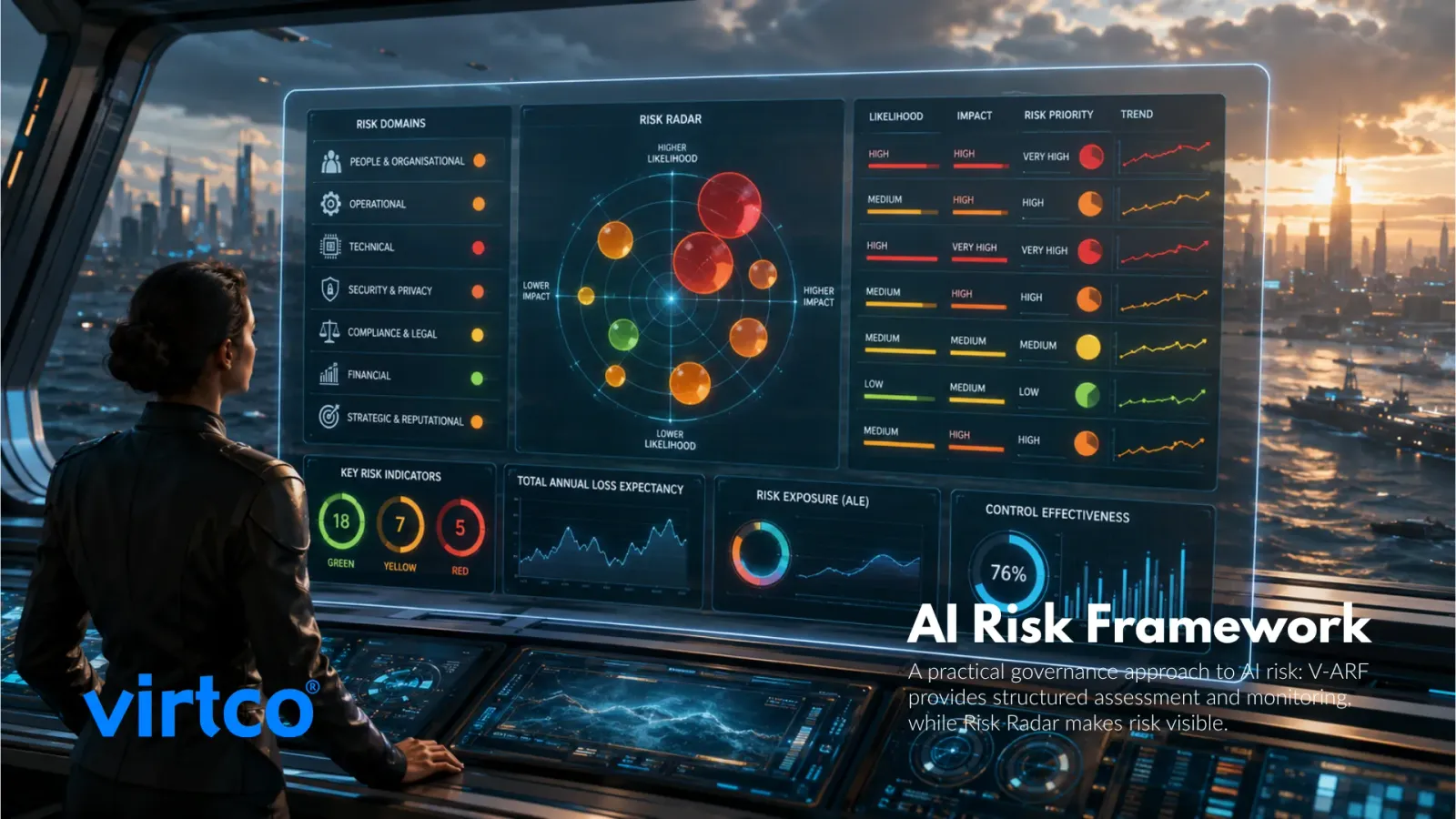
The virtco® Risk Radar™ is the visual companion to V-ARF. Its purpose is to make delivery, adoption and operational risk clear enough for steering groups, sponsors and boards to act on.
Rather than hiding AI risk in a long register, the Risk Radar shows where attention is required across the main risk domains. It helps leaders see whether a programme is broadly balanced or whether one area, such as data governance, user adoption, technical readiness or compliance, is becoming the limiting factor.
The V-ARF specification describes the Risk Radar as a decision-oriented visualisation. It plots risks by domain, likelihood, impact and ease of elimination, helping leaders see not only which risks are serious, but which are practical to address first.
In a steering or board conversation, this makes risk easier to discuss:
- Domain shows where the risk originates.
- Proximity to the centre indicates likelihood or urgency.
- Bubble size represents impact or financial exposure.
- Colour can show treatment status, KRI position or ease of elimination, depending on the reporting view.
This matters because AI risk is rarely isolated. A weak data foundation can become a compliance issue. Poor change management can suppress adoption and destroy the forecast benefit. A technically successful pilot can still fail if no one owns the operating model after launch.
How V-ARF fits into benefits-led delivery
virtco®’s 3-Bees™ framework organises software and change engagements into three phases: Benefits Capture, Benefits Mapping & Profiling, and Benefits Realisation. Its defining principle is that success is measured in realised business benefit against a baseline, not by software output.
V-ARF strengthens each phase.
1. Benefits Capture: surface risk before commitment
In the first phase, the organisation defines the case for change, identifies target benefits, captures baselines and names benefit owners. This is also where teams identify dis-benefits, constraints and risks.
For AI work, V-ARF turns this early discovery into a structured risk view. It asks whether the intended outcome is strategically valid, whether the organisation is ready to adopt the change, and whether the technical and governance foundations are strong enough to proceed.
The framework also helps identify whether a proposed AI system is low, medium, high or unacceptable risk, and whether it requires a lightweight, standard or full assessment.
2. Benefits Mapping & Profiling: connect controls to value
The second phase turns benefits into a measurable plan. virtco® builds a benefits dependency map linking enablers, business changes, intermediate benefits, end benefits and strategic objectives. Each benefit profile captures ownership, baseline, target, measurement method, dependencies, timeline, dis-benefits and risks.
V-ARF adds the risk discipline to that map. It helps answer questions such as:
- Which dependencies are critical to safe delivery?
- Which controls must be in place before a pilot becomes production?
- Which KRIs should be monitored after launch?
- Which risks threaten adoption, benefit realisation or compliance?
- Which risks are acceptable, and which require mitigation before the next stage gate?
- Does the cost of a proposed control make sense when compared with the expected loss avoided?
3. Benefits Realisation: prove the benefit and keep watching the risk
The third phase puts the capability into users’ hands, measures adoption and reviews actual benefit against forecast benefit. virtco® also conducts a business readiness assessment before release, drawing on V-ARF readiness and control inputs.
This is important. AI risk does not end at go-live. Model behaviour, user behaviour, process exceptions and regulatory expectations can all change. V-ARF therefore supports continuous monitoring, while the Risk Radar keeps those changes visible to the people accountable for the outcome.
From RAG reporting to risk intelligence
Many organisations still rely on red, amber, green (RAG) status reporting. RAG can be useful, but it can also compress complex risk into an over-simple status colour.
The Risk Radar gives a more useful executive view. It encourages the governance conversation to move from “Is the project green?” to better questions:
- Which risk domains are deteriorating?
- What is driving the change?
- Is the risk inside or outside agreed appetite?
- What do the KRIs show?
- What is the expected financial exposure?
- Which controls offer the best reduction in risk for the investment required?
- Does the business case still hold?
- Should we continue, pause, narrow the scope or change the intervention?
This aligns with virtco®’s wider Outcome Engineering thinking: governance for AI and automation should focus not only on project delivery risk, but also on value realisation risk and the operational risks associated with advanced automation. Continuous assessment and monitoring are needed because governance cannot be reduced to occasional steering committee updates when AI agents and automated workflows operate inside live business processes.
What the framework helps prevent
Used properly, V-ARF and the Risk Radar help reduce several common AI failure patterns.
AI as a solution in search of a problem
The framework links risk assessment to strategic objectives, measurable benefits and risk-adjusted business cases. That helps prevent teams from buying tools or building pilots without a clear business outcome.
Pilot purgatory
The AI readiness material identifies pilot purgatory as a common problem: organisations can run isolated pilots but fail to scale because the underlying infrastructure, skills or operating model is not ready. V-ARF helps expose those constraints before a pilot is mistaken for a production-ready capability.
Hidden shadow AI
V-ARF treats AI discovery as a formal activity. That includes finding unauthorised or informal AI use, assessing it, and deciding whether to approve it, approve it with controls, redirect it to a safer alternative or prohibit it. The framework’s shadow AI approach favours education and official routes to safe use over punishment for first offences, while still allowing high-risk use to be blocked where necessary.
Hidden data and governance weaknesses
The AI readiness assessment uses dimensions such as strategy, data, infrastructure, talent and governance to diagnose whether an organisation is genuinely ready for AI. V-ARF carries that same principle into delivery: a strong idea is not enough if the controls are weak.
Adoption failure
AI changes how people work. If users do not understand, trust or adopt the new capability, the benefit will not land. V-ARF therefore treats people and organisational risk as a core domain, not an afterthought.
Ethical or compliance drift
As AI systems become more autonomous, the risk is not only that they fail, but that they drift away from agreed ethical, legal or strategic boundaries. V-ARF addresses this through continuous monitoring, event-based reassessment and framework evolution.
Misallocated control spend
Not every risk can be treated at once. V-ARF’s use of ALE, KRI thresholds and cost-benefit analysis helps leaders make better control investment decisions. The aim is to avoid spending heavily on low-priority risks while underfunding controls for risks that could materially damage the organisation.
When should an AI risk be reassessed?
AI risk scores should not be static. V-ARF defines both event-based and time-based reassessment triggers.
Immediate reassessment is required when there is a significant event, such as:
- an AI incident or near miss;
- a KRI moving into a red threshold;
- a major model, dataset or system change;
- a new regulation or regulatory interpretation;
- a change in business context, such as an internal AI tool becoming customer-facing;
- a new threat, such as a published prompt injection or data poisoning technique.
Periodic review is also built in. Critical risks require more frequent reassessment than low risks. The point is simple: AI risk management must keep pace with the system and the environment around it.
What leaders should expect from a V-ARF engagement
A V-ARF-led engagement should produce more than a risk register. It should create a practical governance rhythm that supports decisions.
Typical outputs include:
- an AI asset inventory, including known and discovered shadow AI;
- risk tiering by system impact, business criticality and data sensitivity;
- a structured assessment across the seven V-ARF risk domains;
- a prioritised risk and dependency register;
- qualitative likelihood and impact scoring;
- KRIs with green, yellow and red thresholds;
- ALE and cost-benefit analysis for material risks and controls;
- clear ownership for risks, controls and mitigations;
- readiness inputs for stage-gate decisions;
- a Risk Radar view for steering and board reporting;
- AI incident playbooks and post-incident review routines;
- recommendations linked to business value, not just technical remediation;
- a route from pilot to production that includes adoption, controls, measurement and sustainment.
That final point matters. virtco®’s delivery approach is benefits-led, not output-led. It establishes baselines, defines benefit ownership, measures actual outcomes and uses realisation reviews to evidence return on investment.
How V-ARF integrates with enterprise governance
V-ARF is designed to plug into existing governance, risk and service management structures rather than sit beside them.
The framework maps to COBIT 2019, including governance, benefits delivery, risk optimisation, resource optimisation, stakeholder engagement, managed risk, managed security, change management, operations, incidents and compliance. It also aligns with ITIL 4 practices such as risk management, information security management, compliance management, service design, service level management, monitoring, incident management, problem management, change enablement and deployment management.
This is important for adoption. Mature organisations rarely need another isolated framework. They need AI-specific controls and decision intelligence to be embedded into the governance mechanisms they already use.
Why virtco® is well placed to deliver this work
AI risk is not just an AI problem. It sits at the intersection of strategy, process, data, security, software, adoption and governance.
virtco® combines more than 30 years of experience solving complex business problems with current capability in AI-powered automation, agentic AI systems, custom software, integration, cybersecurity, compliance, digital transformation and user adoption. That combination is important because many AI risks only become visible when technical feasibility is tested against real business operations.
The result is a practical approach: define the outcome, understand the constraints, expose the risk, quantify what matters, build the controls, visualise the position, and keep measuring after launch.
If your organisation is exploring AI, scaling pilots or trying to bring shadow AI under control, speak to virtco® about building a safer route to AI value.
The leadership takeaway
AI risk cannot be delegated entirely to technology teams, legal teams or data teams. It needs shared governance, clear ownership and a live view of how risk is changing as the organisation learns.
The virtco® AI Risk Framework™ gives that governance a structure. The virtco® Risk Radar™ makes it visible. Together, they help organisations move beyond AI enthusiasm and towards AI capability that is measurable, controlled and safe enough to scale.